
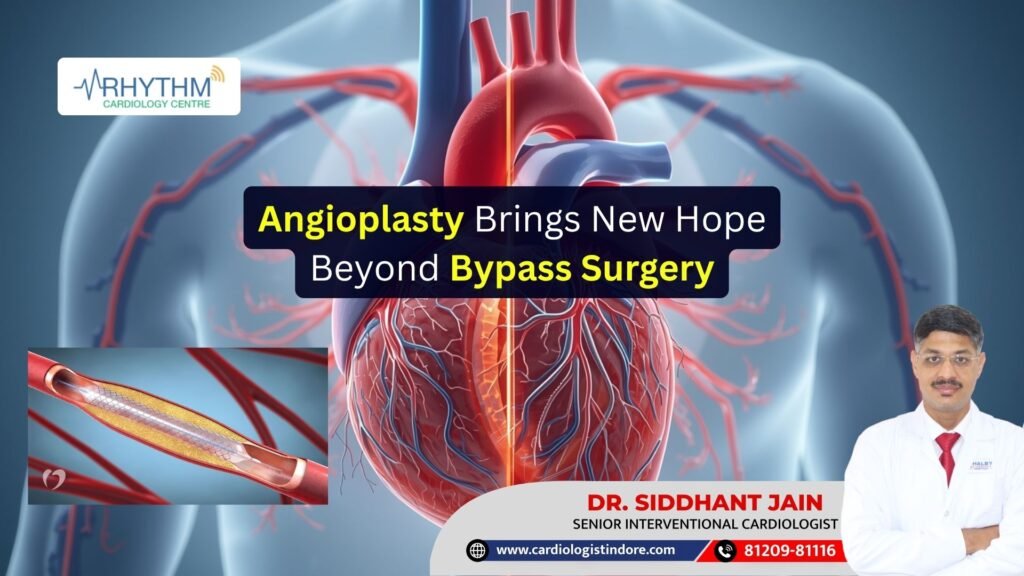
Why Angioplasty Offers New Hope: Know Angioplasty specialist in indore, Dr. Siddhant Jain
Heart bypass surgery has long been considered the only solution for patients with multiple blockages in their arteries. But today, many who were once told they had no option other than open-heart surgery are finding new hope in advanced angioplasty. Angioplasty specialist in Indore, Dr. Siddhant Jain, emphasizes that the latest technologies have transformed how heart disease is treated, offering safer, less invasive alternatives with faster recovery.
Angioplasty specialist in Indore, Dr. Siddhant Jain, explains, “For decades, bypass surgery, or CABG (Coronary Artery Bypass Grafting), saved countless lives. Yet it is still a major operation involving opening the chest, stitching arteries, and weeks of recovery. Some patients also face long-term complications. With revolutionary innovations in angioplasty devices and imaging, however, many complex cases can now be managed without the trauma of bypass surgery.”

In countries like Japan and Korea, bypass surgery is avoided in most cases, partly due to cultural and religious beliefs. There, nearly 90 to 95 percent of blockages are treated with advanced angioplasty. In India, bypass remains more common, but with tools like IVUS, rotablation, orbital atherectomy, and new-generation stents, angioplasty specialist in Indore, Dr. Siddhant Jain, says patients now have access to minimally invasive solutions that were once considered impossible.
What is Angioplasty?
Angioplasty is a procedure where doctors use thin tubes, called catheters, inserted through the wrist or leg to open blocked heart arteries. Earlier, it involved balloons and stents, but many blockages were considered too complicated for this method. Today, advanced devices allow specialists to treat even the most difficult cases successfully. According to angioplasty specialist in Indore, Dr. Siddhant Jain, this approach has become a breakthrough in cardiac care.
Technologies That Changed the Game
-
IVUS (Intravascular Ultrasound): A tiny ultrasound probe inside the artery provides a live, detailed picture of blockages, guiding precise stent placement.
-
IVL (Intravascular Lithotripsy): Uses sound waves to break down calcium in rock-hard arteries, making them ready for stenting.
-
Rotablation and Orbital Atherectomy: A diamond-coated drill gently sands away hardened plaque in arteries that were once impossible to open.
-
Cutting and Scoring Balloons: These balloons create fine cuts in tough blockages, helping stents expand fully and last longer.
-
Bifurcation and CTO Techniques: Allow treatment of blockages at branch points and long-standing total closures with high success rates.

Why It Matters for Patients
Until recently, patients with multiple blockages or heavily calcified arteries were routinely sent for bypass. Today, many such cases can be managed with angioplasty instead. The benefits are clear:
-
No chest cuts or stitches, just a small puncture in the wrist or leg.
-
Most patients walk the same day and leave the hospital within 24–48 hours.
-
Less pain, less blood loss, and lower risk of infection.
-
Comparable results when done with modern devices and expert guidance.
-
Safer for older or high-risk patients.
How Safe Is It?
According to angioplasty specialist in Indore, Dr. Siddhant Jain, “Modern angioplasty, when performed with advanced imaging and planning, has a success rate above 95 percent even in complex blockages. IVUS ensures stents are placed accurately, reducing future problems. At hospitals with round-the-clock cardiac care, outcomes are often similar to or better than bypass.”

Who Can Benefit?
-
Patients advised bypass but anxious about open-heart surgery.
-
Elderly patients or those with illnesses like diabetes or kidney disease.
-
Patients with multiple or branch blockages, or arteries blocked for years.
-
People who had a bypass earlier but developed new blockages.
A New Era in Heart Care
Bypass surgery still has its place, but it is no longer the only choice. With advanced angioplasty methods like IVUS, IVL, rotablation, cutting balloons, and CTO strategies, patients can now be treated with far less pain and quicker recovery. Angioplasty specialist in Indore, Dr. Siddhant Jain, advises families facing the fear of bypass to always consider a second opinion at a center experienced in complex angioplasty. It could reveal a simpler and safer option for a healthier future.